
OT Readiness and Recovery Services
Most manufacturers are not as prepared for disruptions as they believe. Actemium Avanceon’s OT Readiness & Recovery Services focus on one critical outcome: ensuring your plant can respond and recover quickly when something breaks.
The Problem Isn’t Failure, It’s Recovery
Failures are inevitable in complex OT environments, what varies is what happens next.
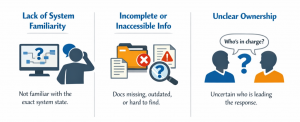
When something breaks, recovery is often delayed by three things:
- Lack of System
Familiarity - Incomplete or Inaccessible Info
- Unclear Ownership
These are not technical failures, they are readiness gaps.
Most OT environments weren’t built all at once. They evolve over years through expansions, upgrades, vendor changes, and personnel turnover.
The result is a system that works but is difficult to support consistently under pressure.
A Practical Framework for OT Readiness & Recovery
Preparedness is not a single activity, it’s built over time.
Our OT MSP framework outlines how manufacturers move from reactive support to structured, repeatable recovery capability—an approach Actemium Avanceon applies in real plant environments.
Establish a clear picture of your OT environment. Understand What You Actually Have.
Focus areas:
- PLCs, HMIs, MES, SCADA, networks, servers, and more
- System architecture and dependencies
- Existing documentation and backups
- Gaps in visibility and ownership
You cannot recover what you don’t fully understand.
Limit the likelihood and impact of disruptions. Reduce Operational Exposure.
Focus areas:
- Patch management and version control
- Network segmentation
- Secure remote access
- User and role-based access control
Reducing exposure lowers the frequency and severity of incidents—but does not eliminate them.
Ensure issues are visible before they escalate. Identify Issues Early On.
Focus areas:
- OT system monitoring (PLCs, SCADA, servers)
- Network and anomaly detection
- Alerting and event visibility
Early detection reduces response time, but only if recovery is defined.
Establish a structured, repeatable response. Define How Recovery Happens.
Focus areas:
- Incident response playbooks
- Roles and responsibilities
- Escalation paths across plant, IT, and corporate
- Backup and restore procedures
Most delays during incidents come from uncertainty, not technical complexity.
Validate readiness before an actual incident. Test Under Real Conditions.
Focus areas:
- Tabletop exercises (TTX)
- Failure and recovery scenarios
- Backup restoration testing
- Cross-team coordination drills
Preparedness that isn’t tested cannot be relied on.
Continuously strengthen recovery capability. Improve Over Time.
Focus areas:
- Post-incident reviews
- Documentation updates
- Process improvements
- Standardization across sites
OT environments evolve—readiness must evolve with them.
Where Most Approaches Fall Short
Many organizations invest in monitoring, cybersecurity tools, and preventive maintenance. These are necessary but they don’t answer:
- Can systems be restored quickly?
- Does the response follow a clear process?
- Do the right people already understand the system?
The issue is not whether problems occur. It is whether recovery is structured, predictable, and repeatable when they do. Read what this looks like in practice: Prevention Isn’t Enough and How Internal vs External Recovery Approaches Differ .
This is the gap Actemium Avanceon’s approach is designed to address.
If this sounds familiar, it may be time to look more closely at your recovery readiness, without committing to a large project, long evaluation cycle, or significant upfront investment.
What Prepared Recovery Looks Like
Effective OT Readiness & Recovery is practical, not theoretical. It ensures that during an incident:
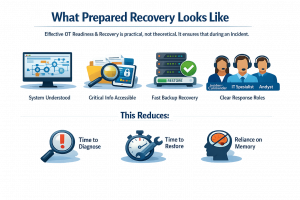
- The system is already understood
- Critical information is accessible
- Backups can be restored without delay
- Response roles are clear
This reduces:
- Time to diagnose
- Time to restore
- Reliance on individual memory
When This Becomes Urgent:
Most organizations address readiness after:
- A major outage
- A cyber incident or audit
- Loss of a key team member
- Integration of a new or unfamiliar system
These events don’t create the problem, they expose it. Learn Why break/fix support models fall short in modern OT environments.
How Engagement Typically Begins
Many organizations begin evaluating readiness after an operational event, audit finding, or internal concern about system support.
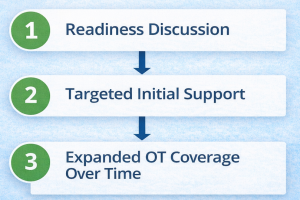
Engagement typically starts with a structured discussion focused on current conditions. This may include reviewing:
- documentation practices and system visibility
- backup and recovery processes
- response ownership and escalation paths
- areas of operational risk
This is not a formal assessment or large-scale engagement. It is an initial step to understand how systems are currently supported and where gaps may exist.
From this point, Actemium Avanceon can introduce OT MSP support in a defined scope and expanded over time as system familiarity and confidence develop.
Engagement is intentionally structured to be low-friction. Most organizations start with a focused scope rather than a large commitment, allowing teams to build familiarity and confidence before expanding support.
Timing and cost vary based on system complexity and starting conditions, but initial engagement is designed to be practical and accessible, not a major upfront investment.
Schedule an OT Readiness Discussion 
Understanding current preparedness is the first step toward improving recovery capability. A readiness discussion helps evaluate:
- whether backups can be restored under real conditions
- how documentation supports response
- who is responsible during incidents
- where recovery risk exists today