
Industrial Data Operations
Are you getting the value you expect from your data on the plant floor? Actemium Avanceon’s DataOps team is helping manufacturer’s turn existing data into measurable operational improvement.
Actemium Avanceon’s approach
Our DataOps approach focuses on one critical outcome: turning industrial data into better operational decisions.

Rather than starting with large, complex transformation initiatives, Data Operations builds capability over time, beginning with the data you already have and progressing step-by-step toward deeper insight, predictive understanding, and integrated improvement.
This approach reflects how manufacturing organizations actually adopt data and analytics in practice: incrementally, with validation at each stage.
A Practical Path from Data to Improvement
Data Operations is not a single project. It is a progression.
Each phase builds on the previous one, ensuring that data becomes increasingly aligned with the process, the operation, and the decisions that drive performance.
The first step focuses on accessing and organizing data from existing OT systems.
This may include:
- connecting to historians, MES, and control systems
- extracting relevant production and process data
- aligning data across systems by time, events, and states
- establishing vendor-neutral connectivity using OPC UA, MQTT, and APIs
The objective is to make data available without disrupting operations.
Raw industrial data is not immediately usable. Data Operations adds context by:
- mapping tags to process meaning
- defining production states and conditions
- aligning data to equipment, batches, or workflows
- structuring data into a process-oriented model aligned to ISA-95
This step is critical. Without proper context, even the most advanced analytics or AI will produce incomplete or misleading results because the data doesn’t reflect how the process actually operates. See what a strong data foundation looks like in practice.
Once data is structured, it can be used to improve visibility.
Capabilities may include:
- Process-focused dashboards
- Visibility into variability, losses, and performance drivers
- Alignment between operations, engineering, and leadership
- Faster access to answers for production questions
This moves organizations from data collection to operational awareness.
With structured data in place, deeper analysis becomes possible.
This includes:
- Identifying sources of variability
- Understanding relationships between process variables
- Uncovering hidden inefficiencies or constraints
- Validating assumptions with real plant data
This is often where organizations first see measurable value.
Advanced analytics are introduced only after data is prepared and understood.
This may include:
- Predictive models for process behavior
- Anomaly detection and pattern recognition
- Identification of optimal operating conditions
- Forecasting quality or performance outcomes
These models are grounded in real process behavior, not theoretical assumptions.
Over time, insights are integrated back into operations.
This may include:
- Embedding models into control systems or workflows
- Automated recommendations or setpoint adjustments
- Real-time monitoring and alerts
- Scaling across lines, assets, or sites
At this stage, DataOps becomes an ongoing operational capability, not a one-time initiative.
The Problem Isn’t Data. It’s Usability.
Most plants already have:
- Historians collecting time-series data
- MES systems tracking production
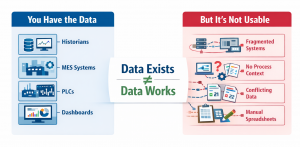
- PLCs generating high-frequency signals
- Dashboards reporting on performance
But despite this, data rarely supports real-time decisions. Instead:
- Data is fragmented across systems
- Signals lack process context
- Multiple sources of truth reduce trust
- Analysis requires significant manual effort
- Teams rely on spreadsheets and workarounds
These are not technology gaps, they are usability gaps.
Most systems were built to report what already happened, not to support real-time decisions or answer operational questions when they matter. Read how manufacturers are shifting from dashboards to real-time answers.
Why Most Data Initiatives Stall
Many manufacturers have already tried analytics, AI, or data platforms. Yet results often fall short. Common approaches fail because:
- Dashboards show what happened, but not why
- Data platforms organize data, but don’t make it usable
- AI initiatives start too big, without validated foundations
In many cases, these efforts are disconnected from real process behavior on the plant floor. The result? Limited adoption, unclear ROI, and loss of confidence in analytics initiatives.
If this sounds familiar, it may be worth taking a closer look at what your data is actually telling you.
How This Engagement Typically Begins
Most manufacturers don’t begin with a large data program. They start by answering a simple question: “Is there real value in out existing data?”
Actemium Avanceon’s ImpactNOW™ is designed for exactly that.
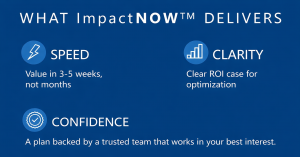
It is a rapid, low-risk entry point that allows manufacturers to validate value before making larger investments.
In a matter of weeks, ImpactNOW:
- Extracts and contextualizes existing plant data
- Applies exploratory analysis and machine learning
- Identifies and quantifies improvement opportunities
- Delivers a clear, data-backed ROI case
This allows organizations to start with a low-cost investment, prove ROI, and reduce risk before committing to a broader DataOps or analytics initiative.
See how this approach uncovered $2M/year in hidden startup waste.