
Unlocking Hidden Factory Value with ImpactNOW™ and Automated Startup Control
Unlocking Hidden Factory Value with ImpactNOW™ and Automated Startup Control
The Problem
Across modern manufacturing, as much as 80% of operational technology (OT) data goes unused.
Plants are equipped with thousands of sensors and control loops producing valuable process information every second, yet most of it remains disconnected from meaningful analysis or decision-making. This lack of visibility limits both operators and leadership decisions are made based on experience rather than insight, and inefficiencies accumulate quietly, invisible to financial reporting.
For our customer, this challenge became clear when we were initially asked to address PID loop instability during production upsets. However, when we began it was what was happening before the loops even stabilized.
ImpactNOW’s Structured EDA workflow revealed that the yogurt separator startup process was highly manual and inconsistent. Operators entered flow setpoints, monitored conditions, and decided when to switch the PID from flow-based to protein-based control purely by judgment and tribal knowledge.
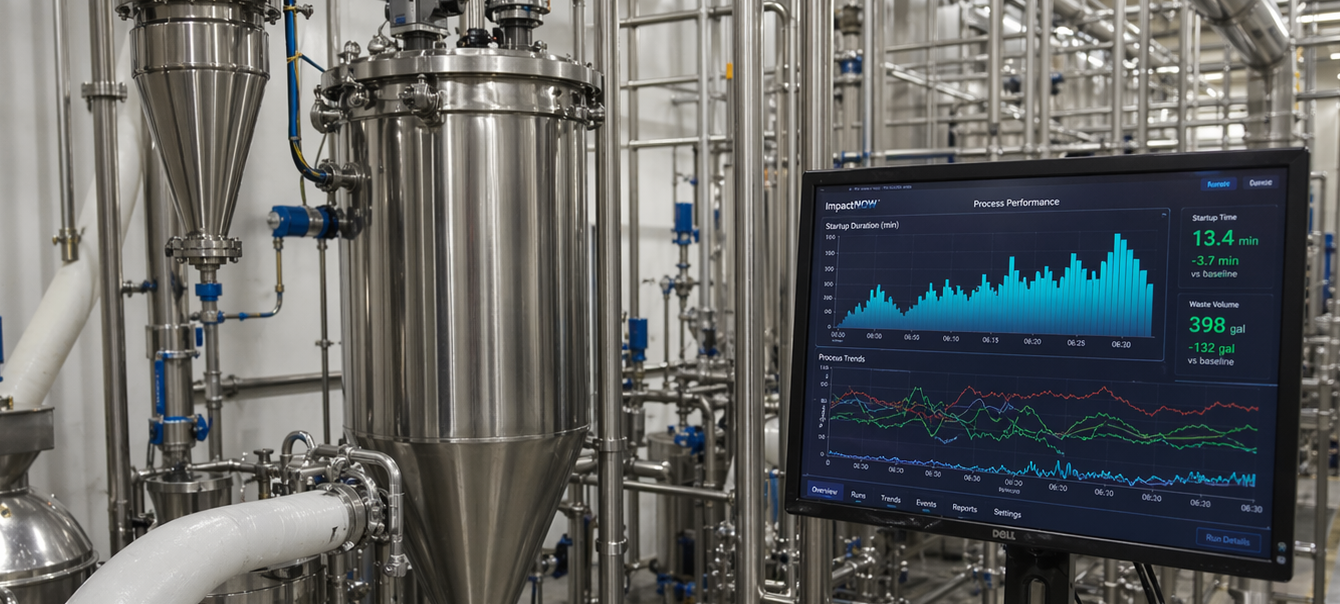
While the perception was that startups took about seven minutes, data showed they averaged 13-14 minutes, with each run producing 390-420 gallons of off-spec product.
In nearly one out of every five runs, systems were accidentally left in manual flow mode for half the batch, leading to in some cases product holds, inconsistent quality, and unmeasured financial waste a classic example of the that ImpactNOW™ is designed to expose.
The Solution
Using a combination of Exploratory Data Analysis (EDA) and Machine Learning (ML), following the structured phases of Actemium Avanceon’s ImpactNOW™ program, our team approached the problem differently. We didn’t start by just tuning the PID loops as directed we started by letting the data reveal the true source of variation.
By analyzing hundreds of historical startup runs, ML models revealed consistent patterns: some operators achieved stable, in-spec conditions in as little as six minutes. These repeatable “golden signatures” showed that faster, more efficient startups weren’t random they were predictable and therefore could be automated.
With those insights, we developed an Auto Sequencing algorithm that detects when product quality has stabilized and automatically transitions the separator from flow to protein control.
This eliminated manual judgment, standardized the startup process, and provided operators and engineers with clear visibility into every step of the transition. The solution went live on the first separator in June 2025, and performance data immediately validated the accuracy and repeatability with measurable ROI.
The Benefits
The results were measurable and immediate. The automated startup sequence reduced startup waste by 3.7 minutes per run roughly 132 gallons of product saved each cycle.
By reducing the time between startup and steady-state operation, the system not only minimized material loss but also stabilized the downstream PID loops, improving consistency and reducing operator workload.
Perhaps even more importantly, the Customer gained data-driven visibility into a part of the process that had never been measured before exactly the type of value ImpactNOW™ is designed to deliver. The same analytics and ML framework that uncovered this opportunity can now be reused across other process areas, giving a replicable toolkit for finding and quantifying hidden factory losses across its network.
The ROI
The financial impact of the Auto Sequencing implementation is substantial. Across 16separators, the verified reduction in waste equates to a total annual savings of approximately $2 million in material costs alone.
Each startup run now avoids roughly $264 in material waste per separator, and the material cost of waste per minute has dropped significantly. The payback period for this initiative was less than three months, and the improvement is sustainable because it’s built directly into the control system, not dependent on operator behavior.
The Next Steps
The success of the Auto Sequencing rollout marks the beginning, not the end, of this Customers digital transformation journey.
The next phase focuses on predictive process control, where the same ML techniques will be used to forecast protein yield based on upstream variability and automatically adjust setpoints before quality is impacted.
By integrating these predictive algorithms directly into the PLC control layer, the process will evolve from reactive control to proactive optimization in short, the project that began as a PID tuning request became a $2 million/year yield recovery initiative, powered by EDA, Machine Learning, Automation, and the structured ImpactNOW™ methodology proving the value of turning unused data into operational and financial excellence.
Ready to uncover hidden losses in your own operation? Connect with our team to explore what your data could be revealing.
Written by: Bruce Slusser