
Unlocking Hidden Value with ImpactNOW: Transforming Raw Scrap Data Into Actionable Operational Intelligence
Unlocking Hidden Value with ImpactNOW: Transforming Raw Scrap Data Into Actionable Operational Intelligence
ImpactNOW™ is a low-risk, low-cost starting point designed to uncover hidden losses and quantify value using your existing data, before committing to larger capital investments.
THE PROBLEM
Across manufacturing environments, scrap and material waste are among the most visible operational losses, but often among the least understood in real time.
At this facility, operators had access to scrap totals through HMI screens, but those numbers existed in isolation. Scrap was tracked but not contextualized. There was no clear way to determine whether performance was acceptable or abnormal in the moment.
A given scrap number could mean very different things depending on production conditions. For example, a run producing 5,000 scrapped units might be considered normal under one set of conditions and a major issue under another. Without visibility into runtime, throughput, material, or machine behavior, operators were left to rely on experience and intuition to make that judgment.
Historical data existed within the plant’s PI system, but it was not structured or presented in a way that supported operational decision-making. There was no consistent baseline, limited ability to compare against historical performance, and no mechanism to alert operators when scrap conditions began to drift.
Like many manufacturers, the plant had no shortage of data, but lacked the context required to turn that data into action.
THE SOLUTION
Using the structured ImpactNOW methodology, Actemium Avanceon began with exploratory data analysis and data contextualization to understand how scrap behavior related to real operating conditions.
Early in the engagement, it became clear that the primary gap was not predictive capability, it was visibility.
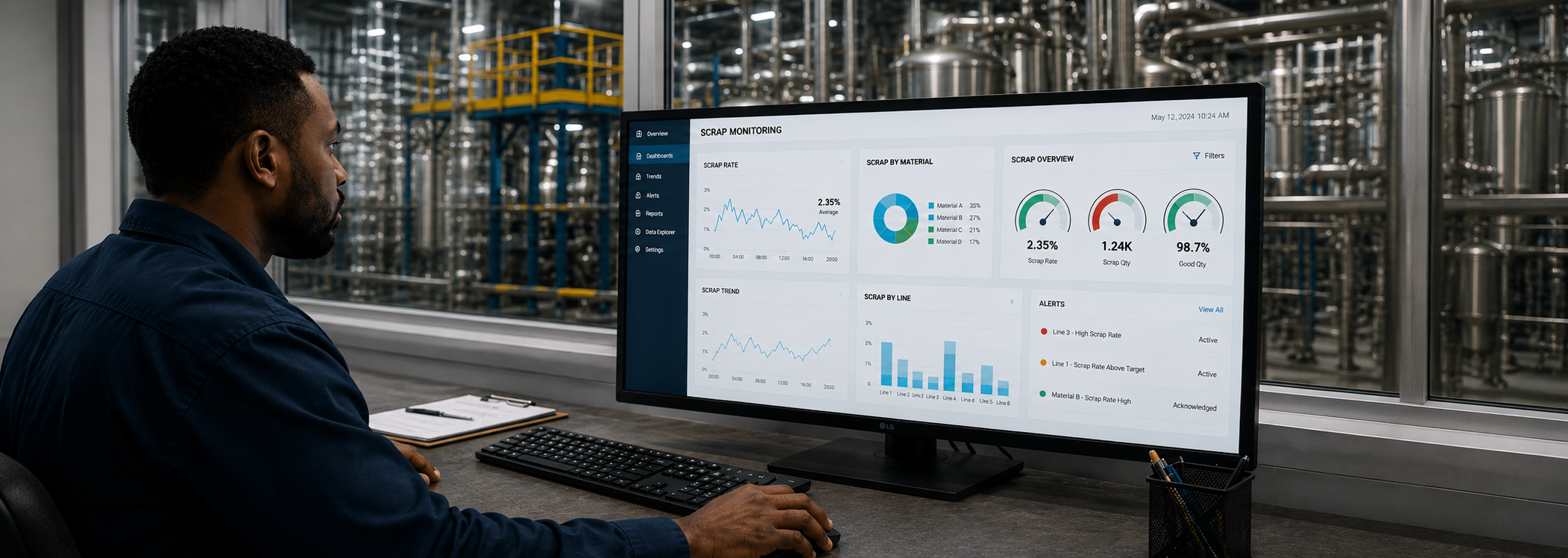
Rather than starting with complex modeling, the team focused on enabling operators to see and understand scrap performance in real time. This led to the development of a custom operational application designed to transform raw historian data into actionable insight.
The application integrates directly with the plant’s existing PI infrastructure, contextualizing scrap relative to runtime, throughput, and operating conditions. It benchmarks current performance against historical baselines and continuously evaluates whether conditions fall within expected ranges.
As the system evolved, it began to surface issues automatically and guide operator response. Key capabilities include:
- Real-time scrap performance visibility across machines and materials
- Contextual benchmarking against historical operating conditions
- Automatic identification of abnormal scrap and waste behavior
- Embedded troubleshooting guidance tied to scrap drivers
What began as a visibility layer quickly a decision-support tool embedded in daily operations, shifting the plant from reactive reporting to proactive operational response.
THE IMPACT
The impact of the application was driven by a fundamental shift in how scrap and waste data was used.
Operators no longer had to interpret raw numbers or rely on experience to determine whether performance was acceptable. Instead, they could immediately see how current conditions compared to expected performance and identify when intervention was required.
More importantly, the operational team could take preventative action earlier in the process, reducing the likelihood of excess scrap and waste before losses accumulated. This shift from reactive reporting to proactive operational response delivered several immediate operational benefits:
- Scrap conditions are identified and addressed in real time rather than after loss occurs
- Decision-making is standardized across operators, reducing reliance on tribal knowledge
- Process consistency improves as performance is measured against clear baselines
By transforming passive data into actionable insight, the application allowed the plant to reduce scrap through earlier detection and improved response—without requiring major system changes or large-scale investment.
Just as importantly, the solution leveraged existing infrastructure and delivered value within months, aligning with the ImpactNOW model of rapid, low-risk operational improvement.
Beyond scrap and waste reduction, the platform established a scalable foundation for broader operational intelligence, with expansion into additional use cases such as OEE, reporting, and cross-site deployment.
THE NEXT STEPS
With real-time scrap visibility established, the plant now has a clear path forward.
The next phase focuses on expanding the same methodology across additional areas of the operation, applying this approach to throughput, downtime, and quality variation.
As data becomes more structured and contextualized, the foundation is being set for more advanced capabilities, including predictive analytics and eventually closed-loop optimization.
This progression reflects the ImpactNOW approach: start with visibility, build context, prove value quickly, and scale over time.
This project highlights a common reality across manufacturing: the challenge is rarely a lack of data; it is the inability to use that data effectively in real time.
By focusing first on visibility and context, ImpactNOW enabled the plant to uncover and act on hidden losses that were previously embedded in day-to-day operations.
What began as a scrap and waste visibility initiative evolved into a scalable operational intelligence capability, demonstrating how a focused, low-risk starting point can drive meaningful, measurable improvement.
ImpactNOW helps manufacturers uncover hidden losses, validate ROI quickly, and build a practical path toward operational intelligence using existing plant data. Contact Us.