
Manufacturing Execution Systems (MES)
A Manufacturing Execution System should not be the goal. Better manufacturing should be the goal.
Less downtime. Better quality. Complete traceability. More consistent operator execution. Faster production decisions. Reliable data. Fewer manual processes. Greater visibility across the enterprise.

At Actemium Avanceon, we help manufacturers achieve those outcomes by combining deep manufacturing experience with modern software engineering, industrial automation, data architecture, and enterprise integration expertise.
Rather than spending years impleenting a massive system before realizing value, we build MES capabilities iteratively. We focus on the highest-value manufacturing problems first, deliver working functionality, learn from actual users, and expand from there.
Better execution today. A stronger digital enterprise tomorrow.
Manufacturing Transformation Should Deliver Value Early and Often
Traditional MES programs can become enormous undertakings, with months or even years passing between initial requirements and working functionality.
The problem is that manufacturing does not stand still while software is being developed. Products change. Processes evolve. Equipment is replaced. Plants add lines. Business priorities shift. And teams learn more about what they actually need.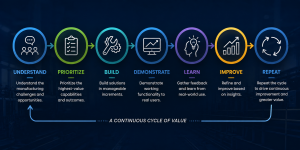
That is why we take an iterative approach.Instead of attempting to define every requirement for an enterprise-wide solution upfront, we identify the most valuable manufacturing capabilities, prioritize them, develop them in manageable increments, and regularly put working functionality in front of the people who will use it.
This allows manufacturers to realize value sooner while reducing the risk of spending years building functionality that no longer reflects the needs of the operation.
Start With the Manufacturing Problem, Not the Software Platform
Successful MES programs begin on the plant floor.
Before recommending technology, we work with operations, engineering, maintenance, quality, IT, production leadership, and operators to understand how manufacturing actually works today.
Common starting points include:
- Limited production visibility
- Excessive or poorly understood downtime
- Manual production and quality reporting
- Inconsistent operator workflows
- Limited material traceability or product genealogy
- ERP and plant-floor disconnects
- Difficult changeovers
- Disconnected plant systems
- Inconsistent processes or KPIs across facilities
We identify the highest-value problem and determine the right manufacturing capability to solve it.
That may involve a commercial MES platform, existing systems, custom software, industrial databases, APIs, cloud or edge technologies, PLC integration, enterprise applications, or a combination of technologies.
The architecture follows the manufacturing need. The manufacturing need does not get forced into a predetermined platform.
Related Insight: Learn Why Your MES Didn’t Fail
Build Manufacturing Capabilities, Not Massive Projects
We view MES as a collection of connected manufacturing capabilities rather than one giant software implementation.
Each capability solves a real operational problem while becoming part of a larger digital manufacturing architecture.
Real-time production dashboards, OEE, downtime tracking, throughput visibility, loss analysis, shift reporting, and performance metrics help teams understand where production losses are occurring and take action faster.
Replace disconnected paperwork and manual quality processes with controlled digital workflows that improve consistency and make quality information easier to access and analyze. Capabilities can include digital inspections, electronic batch records, in-process quality checks, specification management, quality holds, nonconformance and deviation workflows, SPC, electronic signatures, audit trails, and automated specification validation.
Help operators execute production activities more consistently while reducing unnecessary decisions and manual entry. Capabilities can include digital work instructions and guided workflows, setup verification, changeover procedures, material verification, electronic forms, automated data collection, operator prompts, and exception management.
Connect materials, equipment, people, processes, and production events to create a more complete history of how products were made. This provides greater traceability and can improve the speed and accuracy of investigations, recalls, regulatory reporting, and root-cause analysis.
Connect plant-floor and enterprise systems to create reliable information flow and reduce unnecessary manual transactions. Integrations can span PLCs, SCADA, historians, ERP, WMS, CMMS, LIMS, QMS, industrial databases, cloud environments, data platforms, and business intelligence tools.
Create a clearer connection between what the business plans to produce and what is actually happening on the plant floor. Capabilities can include production order management, schedule visibility, dispatching, line assignment, sequencing, material availability, changeover coordination, production status, and schedule adherence.
Control and distribute the right production settings to improve quality and consistency. Capabilities can include recipe and formula management, parameter downloads, setpoint verification, version management, product configuration, change control, approval workflows, and electronic records.
Establish reusable manufacturing standards across facilities while preserving the flexibility individual plants need. This can include standardized data models, KPIs, downtime structures, quality workflows, naming conventions, user experiences, integration patterns, software components, and deployment architectures.
Related Insight: Explore a more flexible approach to manufacturing execution in this blog.
Modern MES Requires Modern Software Engineering
MES is no longer simply a collection of screens connected to a database.
Modern manufacturing environments can include distributed applications, databases, APIs, edge infrastructure, cloud platforms, containers, data pipelines, enterprise integrations, and plant-floor systems.
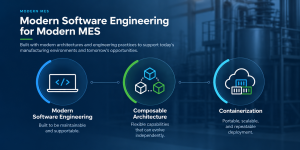
Actemium Avanceon is not only an MES implementation team. We are a software engineering organization with deep manufacturing expertise.
Our approach can include Agile development, evolving product backlogs, incremental releases, source control, automated testing, code review, controlled deployment practices, CI/CD, and separate development, test, staging, and production environments.
We do not use modern technology simply for the sake of using it. The goal is to create manufacturing systems that are easier to deploy, support, scale, and evolve.
Connect the Plant Floor to the Enterprise
MES lives in the middle of manufacturing. Below it are machines, sensors, controllers, automation systems, SCADA, historians, industrial networks, and edge computing.
Above it are ERP systems, business applications, cloud environments, data platforms, analytics, and AI.
Our teams work across both worlds, using modern integration patterns including APIs, OPC UA, MQTT, databases, message brokers, middleware, and other technologies to create reliable information flow without unnecessarily replacing valuable existing systems.
That breadth is especially important in brownfield environments, where manufacturers may already have decades of investment in automation, applications, databases, reporting systems, and legacy MES platforms.
Modernization does not have to mean ripping everything out. It can mean integrating existing systems, gradually replacing applications, standardizing data, adding modern interfaces, or modernizing one manufacturing capability at a time.
MES Creates the Data Foundation for Analytics and AI
MES does more than manage production. It adds context to manufacturing data.
A controller may know a value, but MES can connect that value to the product, order, material, equipment, operator, recipe, batch, quality result, downtime event, or process condition associated with it.
That context turns industrial data into useful manufacturing information.
Reliable, contextualized manufacturing data can support enterprise reporting, OEE and loss analysis, continuous improvement, root-cause analysis, predictive maintenance, advanced analytics, machine learning, and AI-assisted operations.
AI does not eliminate the need for MES. It makes good manufacturing execution data even more important.
Related Insight: See how MES provides the manufacturing context needed to support analytics and AI in this blog.
Designed for Real Manufacturing Environments
Modern MES architecture has to account for more than functionality.
Enterprise Scale: Reusable architectures, manufacturing models, data structures, and integration patterns can help manufacturers scale across facilities without forcing every plant to operate identically.
Cybersecurity & Reliability: Network segmentation, access controls, secure integration, backup and recovery, redundancy, failover, and availability should be considered based on the operational consequences of system failure.
Operator Experience: Plant-floor applications need to work for people operating under real production conditions. Good MES design minimizes unnecessary interaction, reduces manual entry, and gives users the right information at the right time.
Related Insight: Click here to explore what it takes to expand MES successfully across lines, sites, and operations.
Our MES Approach
1.Understand
Understand the operation, business objectives, current systems, pain points, and long-term strategy.
2.Prioritize
Identify the manufacturing capabilities that can create the greatest measurable value.
3.Architect
Determine the appropriate platforms, integrations, data models, infrastructure, security, and deployment strategy.
4.Build & Demonstrate
Develop working functionality in manageable increments and regularly put it in front of stakeholders.
5.Deploy & Measure
Release validated functionality and evaluate whether it delivered the intended operational improvement.
6.Expand
Use what was learned to determine the next capability, production area, line, or facility to improve.
Then the cycle continues.
Why Actemium Avanceon?
MES sits at the intersection of manufacturing operations, automation, software engineering, industrial data, and enterprise technology. Our teams work across those boundaries.
We bring together manufacturing and controls expertise with modern software engineering, integration, data architecture, cloud technologies, cybersecurity, analytics, and enterprise scalability.
That allows us to focus on the manufacturing outcome first, select the technology that best supports it, deliver value incrementally, and build an architecture that can continue evolving with the operation.
The objective is not to deploy the most software. The objective is to make manufacturing better.
Ready to Improve Manufacturing Performance?
Whether you are implementing MES for the first time, replacing a legacy platform, improving OEE and production visibility, digitizing quality, implementing traceability, connecting plant-floor and enterprise systems, standardizing across facilities, or preparing manufacturing data for analytics and AI, we can help identify the right place to begin.
You do not need to have every requirement defined or commit to a massive multi-year transformation before improving the operation.
Start with the manufacturing problem. Build the capability that solves it. Measure the result. Then build what comes next.