Foundation Services
Skip the guesswork, start with a foundation.
Modernization projects often start with a familiar problem: you know something needs to change, but you don’t yet have enough information to define the right project, build a realistic budget, or get everyone aligned.
Foundation Services gives you that clarity for a fixed $15K.
An experienced Actemium Avanceon engineer spends 3–5 days onsite evaluating your environment, talking with the people who operate and support it, and identifying the technical and operational considerations that matter.
You leave with a written deliverable that defines where you are today, what should happen next, and budgetary costs to help you plan the next phase.
More Than a Site Visit
Foundation Services are a defined engineering engagement designed to turn an open-ended challenge into a clearer, more actionable next step.
While every Foundation includes onsite discovery and engineering analysis, the focus of the engagement depends on the problem you are trying to solve. That may mean evaluating an aging control system, defining requirements for a SCADA migration, assessing network readiness, identifying integration opportunities, or understanding machine safety risks.
What happens during the engagement?
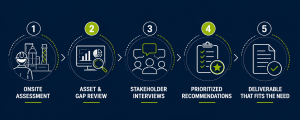
- 1. Onsite Discovery: Our engineers spend time onsite understanding your systems, equipment, architecture, operating environment, and the challenge you are trying to solve.

- 2. Technical & Operational Evaluation: We review the assets, conditions, risks, dependencies, and requirements relevant to your specific Foundation.
- 3. Stakeholder Input: Conversations with operations, engineering, maintenance, IT/OT, and other stakeholders help uncover priorities, constraints, and requirements that may not be visible from the technology alone.
- 4. Engineering Analysis: We bring the technical findings and stakeholder input together to evaluate options, identify gaps, and determine what needs to happen next.
- 5. A Defined Deliverable: Every Foundation ends with a written engineering deliverable, but the format depends on the engagement. That may include an assessment report, URS, FEED study, engineering study, roadmap, or another output appropriate to the work.
Choose the Foundation That Fits the Challenge
Foundation Services can be focused around the area where you need answers most. Each Foundation applies the same structured approach to a different type of challenge, from control system modernization and SCADA migration to connectivity, data integration, and safety.
Explore each Foundation below to see what we evaluate, where it fits, and a real-world example of how a focused assessment helped define the next project.
Understand your plant-floor control environment, including asset inventory, obsolescence, upgrade paths, integration requirements, and modernization priorities.
See It in Practice: Specialty Coatings Manufacturer
Two tanks shared critical equipment across multiple control platforms, while both primary PLCs had reached capacity. The Foundation defined system interfaces, interlocks, handshaking requirements, PLC upgrades, and requirements from operations, engineering, and EHS.
Result: A User Requirements Specification (URS) that turned an open-ended integration challenge into a scopable, biddable automation project with an anticipated investment of approximately $300K.
Evaluate your existing HMI/SCADA environment and establish a practical path for stabilization, upgrades, platform conversion, or migration.
See It in Practice: Batch Manufacturer
Reliability, supportability, and training issues were creating day-to-day challenges in an aging batch environment. The Foundation identified quick wins to stabilize the existing system, uncovered training and job-aid gaps, and defined the longer-term upgrade path.
Result: A prioritized assessment and sequenced roadmap for near-term stabilization and migration to the current AVEVA release.
Assess OT network architecture, segmentation, connectivity, and the infrastructure needed to support more connected operations.
See It in Practice: Multi-Site Food Processor
A growing manufacturer wanted real-time visibility across its operations, but production data was largely collected manually, OEM systems were isolated, and network readiness varied widely across equipment. The Foundation assessed connectivity across approximately 100 assets and four production lines.
Result: A network assessment and connectivity roadmap defining the hardware, configuration, and infrastructure needed for a phased multi-site SCADA and dashboard rollout, while establishing a foundation for future analytics and AI capabilities.
Evaluate how existing plant-floor systems, equipment, and processes can better support operational goals, including system improvements, integration opportunities, modernization priorities, and connections to higher-level platforms.
See It in Practice: Consumer Products Manufacturer
A major retrieval-system upgrade needed to address obsolescence, safety, training, and maintenance at the same time. The Foundation evaluated potential approaches, established priorities, and developed project plans for the key areas requiring improvement.
Result: A Preliminary Engineering Study and roadmap for an approximately $350K obsolescence upgrade project, providing a clearer sequence for implementation and reducing downstream execution risk.
Evaluate automation and machine safety risks, safeguarding gaps, and potential upgrade paths aligned with site standards.
See It in Practice: Building Materials Manufacturer
Multi-vendor production equipment made it difficult to establish one consistent view of machine risk. The Foundation combined OEM documentation review, onsite data collection, and structured hazard and safeguard evaluation to establish required safety performance levels.
Result: An ISO 12100-aligned Safety Risk Assessment (SRA) and SISTEMA report, giving the plant, as risk owner, traceable documentation and a defined path for remediation and required procedural actions.
Not sure which one fits? That’s part of the discovery process. We’ll help identify the right starting point.
You Get Something You Can Use
A Foundation doesn’t end with a conversation or a rough estimate. It ends with a written engineering deliverable appropriate to the work and what needs to happen next.
Depending on the engagement, that may include:
- Assessment Report with current-state findings, priorities, recommendations, and a roadmap
- User Requirements Specification (URS) to establish requirements for accurate project scoping, integration, or vendor selection
- FEED Study to develop a defined improvement far enough to support confident implementation planning
- Engineering Study for more complex upgrades, obsolescence challenges, or multi-phase modernization programs
The goal is to give your team a credible basis for making the next decision, whether that means moving ahead, changing direction, breaking the work into phases, or deciding the project isn’t ready yet.
When the Path Forward Isn’t Clear
You may know where the problem is without knowing what the right project looks like.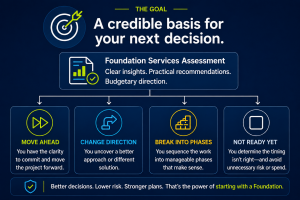
A control system is becoming obsolete. A SCADA migration is on the horizon. Your OT network needs to support greater connectivity. Plant-floor data needs to reach higher-level systems. Or a safety concern needs to be evaluated before improvements can be defined.
Foundation Services helps establish the technical and operational baseline before a larger investment is made.
By evaluating the current environment, identifying gaps and dependencies, and defining priorities, we give your team the information needed to determine the right scope, sequence, and investment for what comes next.
The result is a more informed starting point for capital planning, project development, and implementation.
A Small First Step. A Much Clearer Next One.
A full modernization project can represent a significant investment. Defining it shouldn’t require the same level of commitment.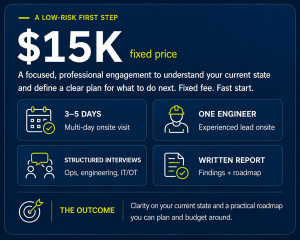
For $15K, Foundation Services provides a focused onsite engineering engagement, structured discovery, and a documented path forward.
And if the right answer is to wait, change direction, or rethink the original project, that’s valuable too.
The deliverable is yours, giving your team something concrete to use for capital planning, internal alignment, future engineering, or the next phase of implementation.
Start With a Foundation
Bring us the problem, opportunity, or modernization idea. We’ll help you turn it into a plan.