
How to Prove ROI From Industrial Data & Analytics Before Scaling
Blog
17 September 2026How to Prove ROI From Industrial Data & Analytics Before Scaling
Manufacturers have been collecting plant-floor data for years through historians, MES platforms, PLCs, sensors, and control systems. Yet having more data has not necessarily made it easier to answer a fundamental business question: What is this data actually worth to our operation?
For manufacturers that have already invested in analytics or digital initiatives without seeing clear returns, the bar is even higher. Leadership may be pushing for more predictive operations and greater use of AI, while engineering and operations teams are understandably cautious about committing significant capital without evidence that it will deliver.
The answer isn’t necessarily another large transformation initiative. A more practical approach is to prove value against a focused operational problem first, then scale based on what the plant data demonstrates. This aligns with Actemium Avanceon’s phased approach to Data & Analytics: establish the right foundation, demonstrate measurable value, and progressively build toward more advanced capabilities.
Start With the Loss, Not the Technology
“We need AI” isn’t an ROI case. Neither is “we need predictive analytics.”
A better starting point is a specific operational problem with a measurable business impact:
- Where are we losing material or creating excess giveaway?
- What is driving process variability?
- What is constraining throughput?
- Which equipment behaviors contribute to downtime or quality issues?
- Where are operators compensating manually for process instability?
Starting with the problem keeps the scope manageable and connects analytics directly to outcomes such as productivity, quality, yield, uptime, and waste reduction.
It also avoids trying to solve the entire plant at once. The initial objective is to gather and contextualize the data needed to understand one meaningful loss, establish its magnitude, and determine whether an improvement opportunity exists.
Use Plant Data to Build the Evidence
Once the problem is defined, data from historians, MES, PLCs, and other OT sources can be examined in the context of how the process actually operates.
That context is important. Industrial data may contain thousands of tags but still lack the production states, equipment relationships, sequencing, and operating conditions required to understand what is really happening.
Exploratory data analysis and machine learning can then help answer four practical questions:
- What is actually happening? Establish the real performance baseline.
- What is driving the loss? Identify patterns, variation, and process relationships.
- What has better performance looked like? Find evidence that the process has already achieved a better result.
- Can the improvement be captured? Determine whether engineering, controls, maintenance, or operational changes could reproduce it.
The goal isn’t to build an AI model for the sake of using AI. It’s to generate enough trustworthy evidence to determine whether an operational opportunity is both achievable and worth pursuing.
Translate the Opportunity Into ROI
An interesting process insight becomes a business case when it can be tied to financial impact.
The basic progression is straightforward:
Current loss → Achievable improvement → Production frequency or volume → Financial impact
That could mean less scrap or giveaway, higher yield, additional throughput, shorter startups, avoided downtime, or fewer quality losses.
Actemium Avanceon’s ImpactNOW™ approach is designed around this type of focused validation, combining discovery, data extraction and contextualization, exploratory analysis and machine learning, ROI quantification, and an optimization path forward before a manufacturer commits to broader implementation.
What It Looks Like in Practice
In one separator startup application, operators believed startup took approximately seven minutes. Historical data showed it actually averaged 13–14 minutes, generating approximately 390–420 gallons of off-spec product per run.
Analysis also showed that some operators consistently reached stable conditions faster. Those successful runs provided evidence of what the process could achieve and ultimately informed an automated sequencing approach.
The result:
- 3.7 minutes of startup waste eliminated per run
- Approximately 132 gallons saved per startup
- Approximately $2 million in annual material savings across 16 separators
- Payback in less than three months
The important part is how the result was reached. The project began with an operational issue, allowed the data to expose the real source and scale of the loss, and then applied analytics, automation, and controls expertise to capture measurable value.
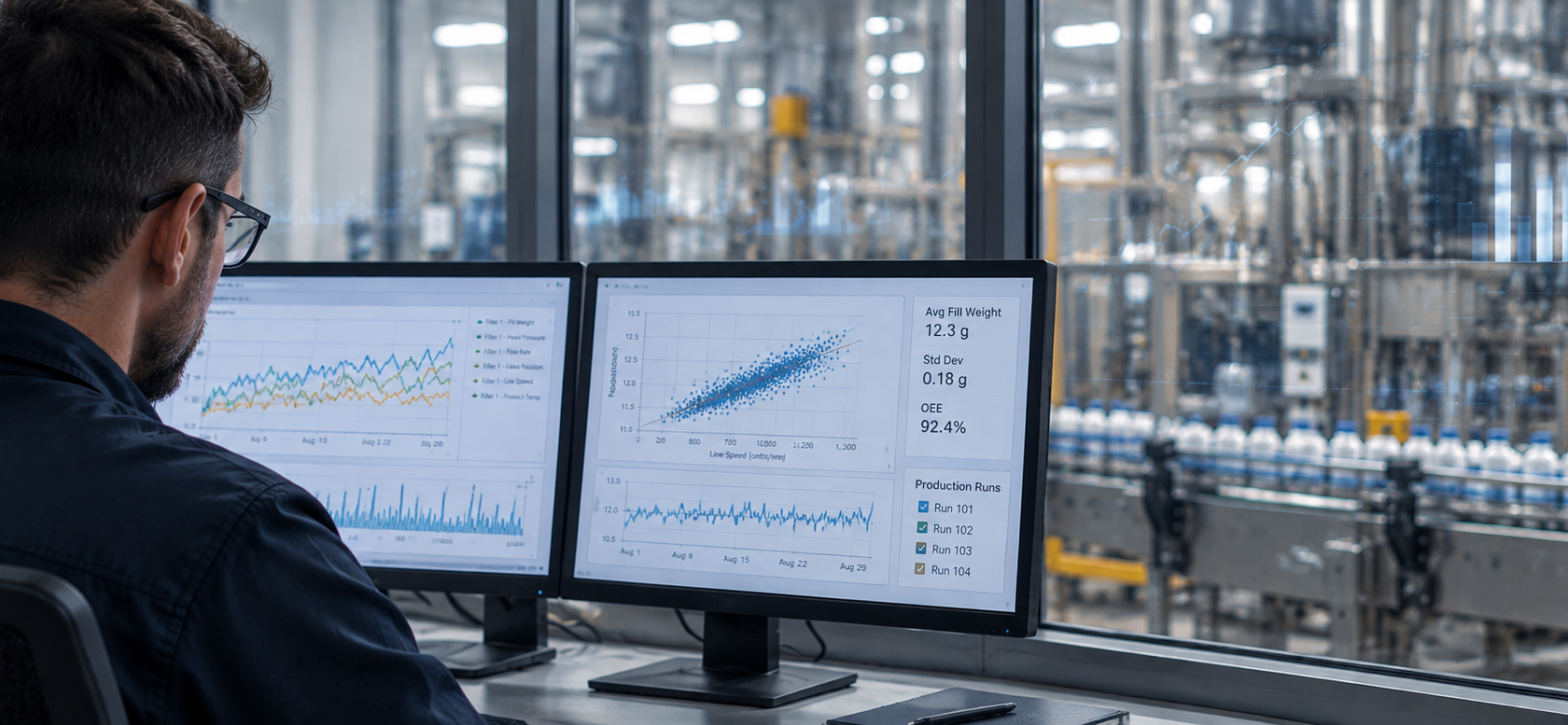
The same methodology has uncovered opportunities elsewhere. In one high-speed filler analysis, head-level modeling identified an achievable 4–8 gram reduction in average overfill, representing an estimated $300,000–$800,000 in annual savings on the filler.
Let the Evidence Determine What Scales
Proving ROI doesn’t mean every analysis has to lead to a larger project. Sometimes the data shows that more foundational work is required. Sometimes the opportunity isn’t large enough to justify further investment.
That is part of the value of starting small.
When an opportunity does demonstrate a compelling return, the next investment can be made with considerably more confidence. A successful application might expand to similar assets, move into real-time monitoring, or create the foundation for predictive analytics and more advanced optimization.
This is why scaling should be a progression rather than a leap. Actemium Avanceon’s DataOps lifecycle moves from foundational data access and contextualization into focused analytics, broader deployment, and continuous optimization as value and maturity increase.
For manufacturers, that changes the question from:
“Should we make a major investment in industrial AI and analytics?” to:
“Can we prove enough value to earn the next investment?”
That is a more practical path forward: start with a real plant problem, prove the economics with plant data, implement what creates measurable value, and scale from results rather than assumptions
Have an Operational Problem Worth Investigating?
Let’s look at what your existing plant data can tell you and whether there’s enough value to justify the next step. Contact Us.
Blog, Data Operations