
OT Readiness & Recovery Services FAQ: What You Need to Know
Blog
20 August 2026OT Readiness & Recovery Services FAQ: What You Need to Know
Every manufacturing operation is different, but the questions we hear are remarkably consistent.
Whether the conversation starts after an unexpected outage, a cybersecurity assessment, or a desire to improve operational reliability, manufacturers want to know one thing: Are we truly prepared if something goes wrong?
For many plants, the answer isn’t obvious until something fails. Backups may be untested, documentation outdated, and critical system knowledge concentrated in one or two people.
OT Readiness and Recovery Services reduce that uncertainty before production is on the line.
Here are answers to 10 of the questions manufacturers ask most often.
1.What are OT Readiness and Recovery Services?
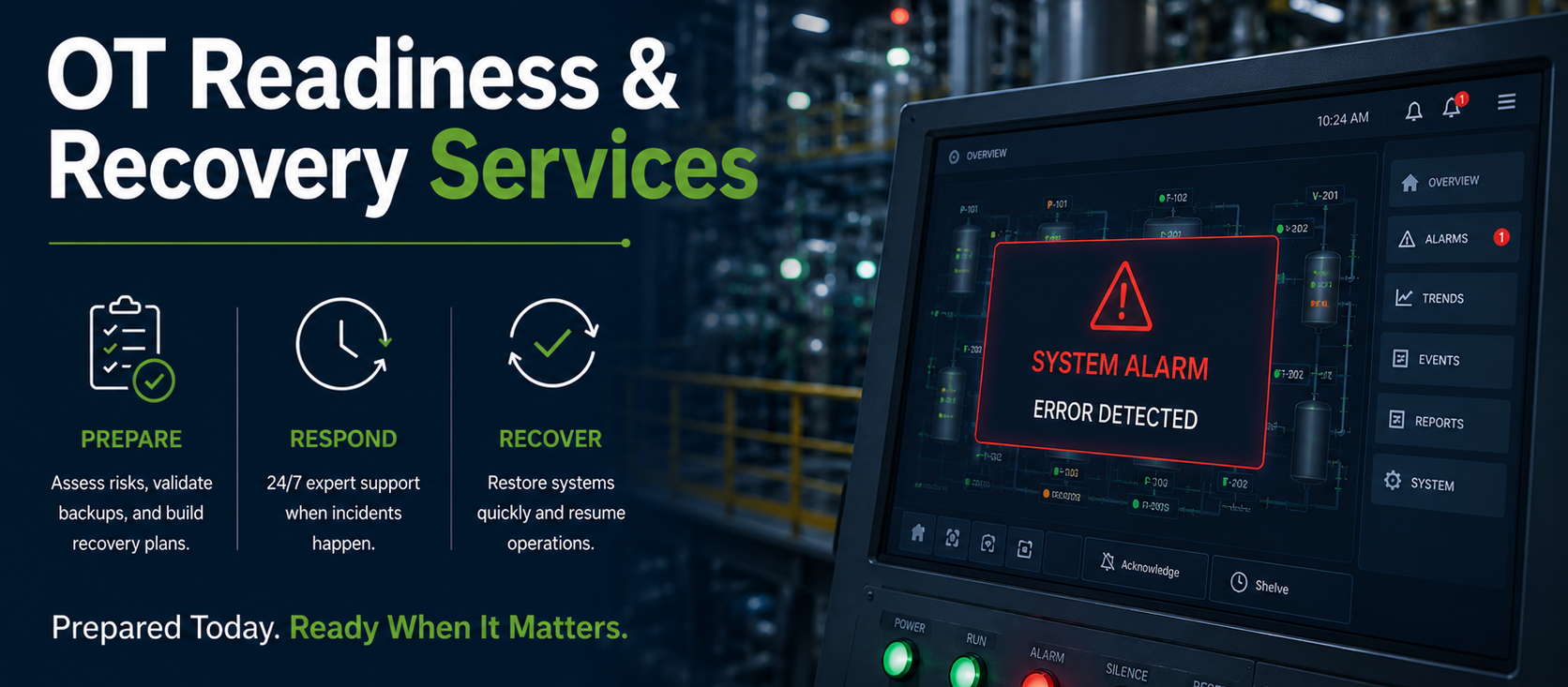
OT Readiness and Recovery Services help manufacturers prepare for operational disruptions before they occur and recover faster when they do.
Rather than waiting for an outage to expose weaknesses, these services strengthen documentation, validate backups, establish recovery procedures, and ensure experienced OT engineers are familiar with your environment before an incident happens.
The result is greater resilience, less uncertainty, and a more confident recovery.
2.How is this different from traditional OT support?
Traditional OT support is often reactive: something breaks, then the response begins.
OT Readiness and Recovery is proactive. Documentation, validated backups, system knowledge, and response plans are established before an incident.
Instead of figuring things out under pressure, your team is better prepared to respond.
3.We haven’t had a major outage. How do we know if we’re actually prepared?
A plant running normally doesn’t necessarily mean it’s prepared to recover from a disruption.
One way to test readiness is through an OT recovery tabletop exercise (TTX). Without interrupting production, your team works through a realistic scenario such as a PLC failure, SCADA outage, cyber event, or unavailable controls engineer.
The exercise tests practical questions: Where is the latest PLC program? Are backups validated? Who has the required access? Who owns the response? When does IT get involved? What happens if your primary controls expert isn’t available?
A tabletop exercise can expose gaps in documentation, backups, access, ownership, and recovery procedures before a real outage does.
The goal isn’t to prove everything is perfect. It’s to find uncertainty while there’s still time to address it.
4.We already have an internal OT team. Why would we need this?
Your internal team knows your operation better than anyone. The goal isn’t to replace them, but to support them.
OT professionals are often balancing projects, maintenance, troubleshooting, and production support. Readiness activities can become secondary because keeping the plant running comes first.
OT Readiness and Recovery adds dedicated engineering resources focused on preparedness, response, and recovery, providing additional expertise while reducing dependence on any single individual.
5.Doesn’t cybersecurity already protect us?
Cybersecurity is essential, but detection and recovery are not the same thing.
Security tools can identify threats and generate alerts. OT Readiness and Recovery focuses on what happens next: restoring operations with available backups, current documentation, established recovery procedures, and experienced OT engineers ready to respond.
Detection identifies the problem. Recovery gets production running again.
6.What does OT readiness actually include?
Every facility is different, but OT Readiness commonly includes:
- PLC, HMI, SCADA, and server backups
- Backup validation and recovery testing
- System and network documentation
- Version control and change management
- Patch management
- Recovery planning
- 24/7 emergency support
- Ongoing monitoring and maintenance
The objective is simple: ensure the information, systems, and people needed for recovery are ready before they’re needed.
7.Can you guarantee recovery times?
No responsible OT provider can guarantee recovery times. Equipment condition, replacement parts, vendor availability, and the nature of the failure can all affect restoration.
What can be controlled is preparedness.
When documentation is current, backups are validated, and engineers already understand the environment, recovery can begin with far less uncertainty.
8.How does OT Readiness and Recovery reduce downtime?
Recovery slows when teams first have to search for answers:
- Which PLC program is current?
- Where are the backups, and have they been tested?
- Who owns the response?
- What changed before the failure?
OT Readiness and Recovery addresses these questions ahead of time so your team can spend less time searching for information and more time restoring operations.
9.What types of manufacturers benefit most?
OT Readiness and Recovery is especially valuable for manufacturers with:
- Multiple production lines or facilities
- Mixed-vendor automation systems
- Legacy PLC, SCADA, or HMI platforms
- Limited internal OT resources
- Critical knowledge concentrated in a few individuals
- High costs associated with production downtime
As OT environments become more complex, maintaining consistent readiness becomes increasingly difficult without a structured approach.
10.How can we get started without committing to a full managed services program?
Most organizations begin with a readiness discussion, not a full managed services engagement.
We’ll review your OT environment and priorities, including documentation, backups, recovery processes, support coverage, and system ownership.
From there, we can identify practical next steps, whether that’s addressing a specific gap, conducting a tabletop exercise, or developing a broader OT Readiness and Recovery strategy.
Preparedness Starts Before an Incident
The best time to evaluate OT readiness is before an outage, cyber event, or equipment failure puts production at risk.
OT Readiness and Recovery helps manufacturers strengthen documentation, validate backups, improve recovery processes, and ensure experienced OT resources are ready when disruptions occur.
Every engagement starts with a readiness discussion to understand your environment, identify potential gaps, and determine practical next steps.
Because when something goes wrong, preparation makes all the difference.
Ready to strengthen your OT readiness? Contact our experts.
Blog, OT Readiness & Recovery